
 Insights
 White Papers
 Ecosystem Radar
article
Svilen and Konstantin Rangelov. Building a category, not just a company

Some founders create products. Some build teams. A much rarer few try to redraw the map of what their region is capable of producing. Svilen and Konstantin Rangelov belong to that last category. With Dronamics, the two brothers have not simply launched another technology company from Bulgaria. They have spent more than a decade pursuing something far more demanding: proving that a company born in this part of Europe can take on aerospace, logistics, regulation, manufacturing and infrastructure all at once, and do so with global ambition.
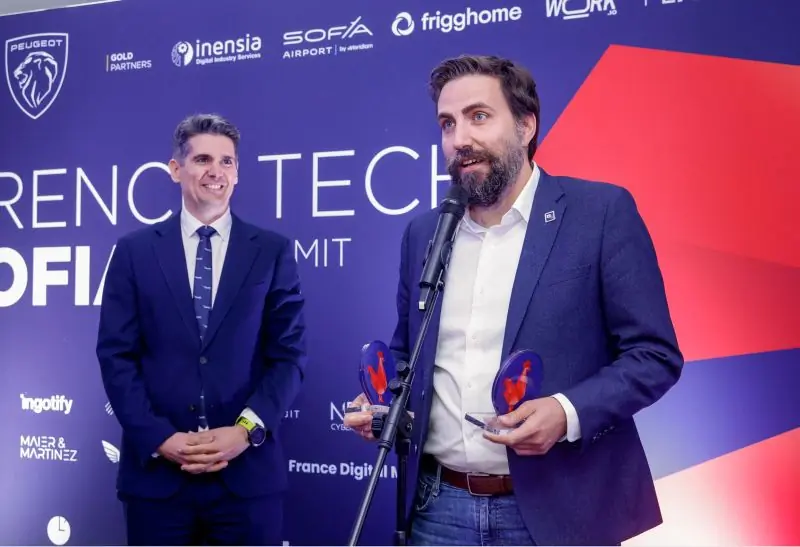
That is why, during the French Tech Sofia Flagship Summit, honoring Svilen and Konstantin Rangelov with the Founder of the Year award felt both natural and meaningful. Awards can sometimes freeze people into titles. This one did the opposite. It pointed back to the long road behind the applause: the years of conviction, the technical hurdles, the skepticism that inevitably surrounds any company bold enough to say it wants to reinvent air cargo from Bulgaria. In a room filled with founders, operators, investors and ecosystem builders, their recognition carried a particular weight. It was not only about commercial promise. It was about endurance, originality and the ability to keep building where many others would have stopped.
The story is also, very simply, a story of brothers. Dronamics was founded in 2014 by Svilen and Konstantin Rangelov. Svilen, the CEO, comes from a business background and has often spoken about being inspired by the inefficiencies of global logistics and the way poor freight connectivity can hold back whole regions. Konstantin, the CTO, is an aerospace engineer. Together, they combined complementary ways of seeing the world: one focused on market friction and economic impact, the other on engineering, aircraft design and technical execution. That combination matters. Many companies have vision. Fewer have both commercial imagination and the discipline to turn it into something that can actually fly.
Their company, Dronamics, sits at the intersection of aerospace, logistics and autonomy. Officially, the company describes itself as designing, building and operating unmanned aerial systems, with a mission rooted in faster, more affordable and more accessible cargo transport. Its flagship aircraft, the Black Swan, was built specifically for freight. According to the company’s published specifications, it can carry 350 kg over up to 2,500 km. Dronamics presents that model as a way to make same-day shipping possible across long distances, especially for sectors such as e-commerce, pharmaceuticals, food and spare parts. The promise isn’t futuristic spectacle for its own sake. It’s a practical answer to a very old economic problem: distance.
And distance, in our region, is never only geographic. It’s infrastructural. It’s administrative. It’s economic. It’s the difference between capital cities and secondary cities, between central hubs and remote communities, between places that are constantly served and places that are always asked to wait. Dronamics’ mission resonates precisely because it speaks to those realities. When a company says it wants to democratize air freight and improve access for remote and underserved areas, that language lands differently in Bulgaria and across CEE than it might elsewhere. Here, we know what uneven connectivity looks like. We know what happens when opportunity concentrates in too few places.
What makes the Rangelov brothers especially important for the Bulgarian and CEE tech ecosystem isn’t only the product they are building. It’s the category they chose to enter. Aerospace is unforgiving. Logistics is unforgiving. Regulation is unforgiving. To attempt all three through a European deep-tech company, and to do it from Sofia, is a statement in itself. Dronamics today describes itself as one of Europe’s most ambitious deep-tech companies and says it includes around 170 experts in aerospace, logistics and technology. Over the last few years, it has also accumulated signals of credibility that matter well beyond branding: the successful first flight of the Black Swan in Bulgaria in 2023, recognition and backing from the European Innovation Council, and a growing role in Europe’s advanced mobility conversation.
Those milestones matter because they create permission for others. Every ecosystem needs visible examples that expand the collective imagination. A founder in Sofia working on industrial software, robotics, climate infrastructure, defense, mobility or another hard-tech field should be able to look at Dronamics and think: yes, this can be attempted from here. Not easily. Not quickly. But genuinely. The Rangelov brothers help move the regional narrative beyond outsourcing, beyond small wins, beyond the idea that globally significant technology must be born somewhere else and only distributed here later. Their work argues the opposite. It says this region can originate serious science-driven, capital-intensive companies and carry them onto the world stage.
There is also something instructive in their leadership style. Dronamics has never felt like a company built around noise. It feels built around insistence. Around method. Around the willingness to keep working on difficult things long after the first press moment has passed. That may be one of the most valuable founder lessons they offer. In many ecosystems, attention often flows too quickly to whatever is newest, loudest or easiest to explain in one sentence. The Rangelov brothers represent another path: patient ambition. The kind that requires years of iteration, technical credibility, institutional trust and a tolerance for complexity.
And perhaps that is why this award feels so right. "Founder of the Year" should not merely celebrate visibility. It should recognize substance. It should point to people whose work changes the level of the game for everyone around them. Svilen and Konstantin Rangelov have done that. As brothers, they have built a company grounded in complementary strengths. As founders, they have chosen one of the hardest possible arenas and kept going. As builders from Bulgaria, they have shown that CEE can produce not only strong software talent and resilient entrepreneurs, but also globally relevant aerospace and logistics innovation.
At French Tech Sofia, we care deeply about the people who make an ecosystem more ambitious than it was before they arrived. People who widen the horizon. People who make younger founders bolder, and the rest of us a little less willing to think in small terms. Svilen and Konstantin Rangelov are those people. Their journey with Dronamics is still unfolding, but its significance is already clear. It’s the story of two brothers who looked at the limits of freight, geography and expectation, and decided those limits were worth challenging. For Bulgaria. For Europe. And for every founder here who needs a reminder that category-defining companies don’t have to come from somewhere else. They can start here.
Last updated on January, 17th 2026 at 10:12 AM.
Written in participation with:

French Tech Sofia
Official French Tech hub – NGO bridging together players in the French & Bulgarian #startup ecosystems #FrenchTechSofia